Small businesses rarely need a robot that can do everything. They need one machine that handles a repeated task safely, fits the floor space, and earns its place in the budget.
The best first use is usually a narrow job with clear steps. That makes the robot easier to set up, measure, and move to another task later.
- Move stock: autonomous mobile robots can carry bins, parts, or finished goods between fixed points.
- Repeat production work: robot arms can load machines, pick parts, or handle simple assembly.
- Clean public areas: floor-cleaning robots can cover open spaces while staff handle people and service work.
Move goods inside a site
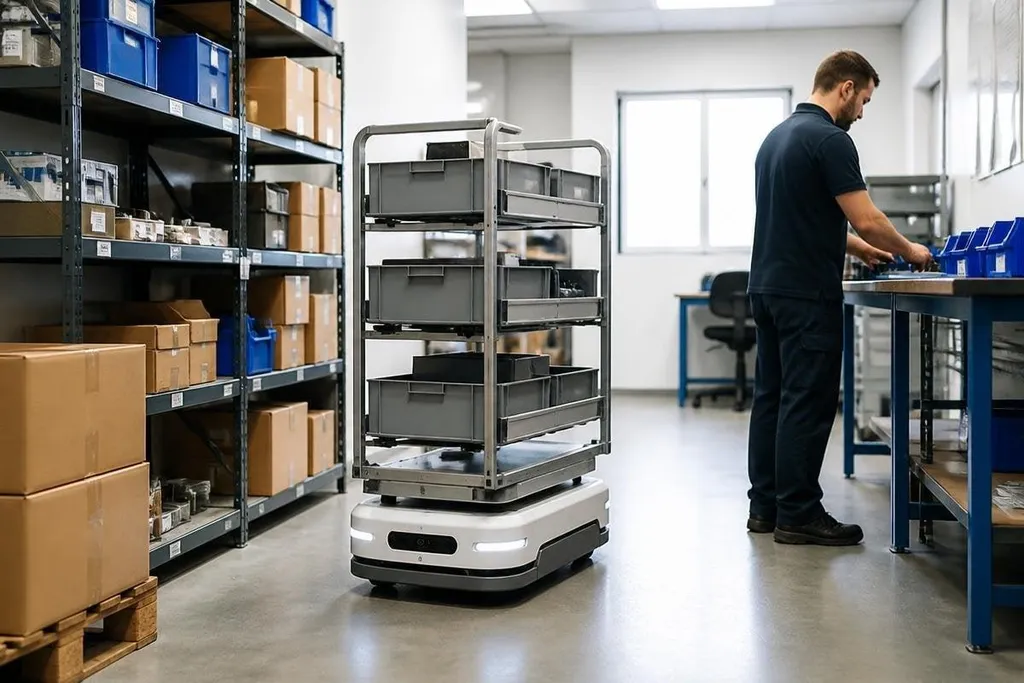
A small warehouse, workshop, or retail back room can lose staff time to repeated trips. An autonomous mobile robot, or AMR, carries a load and uses sensors to move around people and fixed objects.
The useful job is often plain: bring a bin from storage to a workbench, move packed orders to a dispatch area, or carry parts between two machines. The robot needs a mapped route, safe stopping rules, and clear handoff points. If staff still need to guide it for every trip, the setup needs more work.
AMRs suit sites where the route changes during the day. They can work across marked areas without installing a fixed rail, but they still need clear floors, charged batteries, and a person who can deal with blocked paths.
Load and unload machines
A robot arm can take parts from a tray, place them into a machine, and move the finished part to a second tray. This is a good fit when the work repeats and the part arrives in a known position.
A small manufacturer should check the full cell, not the arm alone. The gripper must hold the part, the arm must reach each point, and the machine controls must exchange safe start and stop signals. A vision camera may help when parts are not placed in the same position each time.
These systems can run beside people when the complete setup meets the required safety rules. A cobot is a robot arm built for shared work areas, but the word does not remove the need for a risk check, guarding, or an emergency stop.
Pick, pack, and sort products
E-commerce shops and small distributors face a different problem: many orders, small batches, and items that change often. A robot can pick known objects, place them into boxes, or sort packages by destination when the items and layout stay within its tested range.
The hard part is usually the hand. A gripper that works on boxed products may fail on soft bags, shiny packaging, or objects that overlap in a bin. A camera can locate items, but software still needs clear rules for a failed pick and a damaged package.
A small operator can use robotics reports on cleaning and inspection to compare a floor robot’s claimed coverage with its route, battery life, and response to faults. That matters when the next job involves dust, narrow aisles, or a sensor that needs a person to check it.
Clean floors and inspect simple faults
Cleaning robots fit offices, shops, clinics, and other sites with broad, open floors. They can follow set routes, avoid objects, and return to a charging point, while staff handle edges, stairs, spills, and areas blocked by furniture.
Inspection robots can also check a fixed area for visible faults. A camera mounted on a mobile base or robot arm may spot a missing label, a damaged package, or a part outside a marked position. The result still needs a person when the cost of a missed fault is high.
These uses work best when the task has a clear pass or fail result. They work less well when every case needs judgment, changing tools, or contact with customers.
Pick the first task with care
Before asking which robot to buy, write down the job and check these points:
- Task shape: Can the work be described as repeatable steps with a clear start and finish?
- Work area: Does the robot have enough room to move, stop, charge, and let people pass safely?
- Object range: Will the parts, boxes, or tools stay within the gripper’s tested size and weight?
- Failure plan: Who clears a blocked route, resets a failed pick, or checks a rejected item?
- Cost measure: Will you track hours saved, items handled, errors found, or another result tied to the job?
- Staff role: Can people spend the time saved on work that still needs judgment or contact?
I'd start with internal movement or machine loading before customer-facing work. Those tasks have clearer boundaries, and a failed cycle is easier to spot before it affects a customer.
The right first robot is the one that repeats a costly task with few surprises. If the job changes every few minutes, keep a person on it and spend the budget elsewhere.